
Last month, in a parliamentary reply to my colleague, Wong Shu Qi (Member of Parliament for Kluang), the Prime Minister’s Department stated that there were more than 200 smart phone applications or “APPs” which have been developed by 93 government agencies.[1] A full listing of these applications can be found at the “Gallery of Malaysian Government Mobile Applications” or GAMMA website (https://gamma.malaysia.gov.my/). There’s even an app (Gammy.my) to list down all of these smart phone applications! After going through the ratings and descriptions of some of these “APPs”, I arrived at the conclusion that just because an app is developed for a smart phone, it does not mean that the app is a “smart” app. Here are some of my suggestions to the Malaysian Administrative Modernisation and Management Planning Unit (MAMPU) under the Prime Minister’s Department[2], which oversees ICT and Digitalisation related initiatives of the Malaysian government with regards to making government apps “smarter, more user friendly and effective.
1) Get rid of useless and infrequently used APPs
Not everything needs to be put into an app for public use. Some apps have seen very few downloads while others seem to provide information which very few people seem to want, in ways which are not very user friendly.
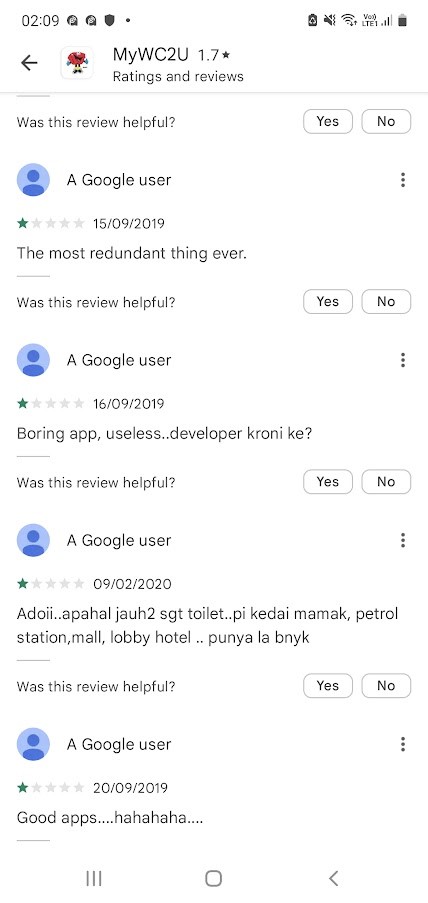
One such example is an app which was launched in October 2021 called “MYWC2U”[3] which allows someone to find the location of the nearest public toilet. This app received a rating of 1.7 out of 5 on Google Play Store with one review stating that this app is “the most redundant thing ever”. If someone really needed to use a toilet in a hurry, I’m guessing that this person would try to find the nearest petrol station or mamak shop using his smartphone rather than to use the MYWC2U app. (Appendix 1)
MAMPU can easily determine which of the 200 apps have not been frequently downloaded and used and ask the relevant agency to either delete these apps or change them to make them more relevant to the public. My own research shows that 97 out of the 200 apps have been downloaded less than 1000 times which means that fully half of the 200 apps which have been developed are basically apps which are not frequently used.
MAMPU should provide recommendations to the various Ministries and Agencies on whether an app is really needed or if it were better for the information to be displayed only on the website or for certain applications to be processed only via a website. For news notifications, it may be better to use other existing apps such as Telegram rather than developing a stand-alone app.
2) Make sure the APP fulfils its function
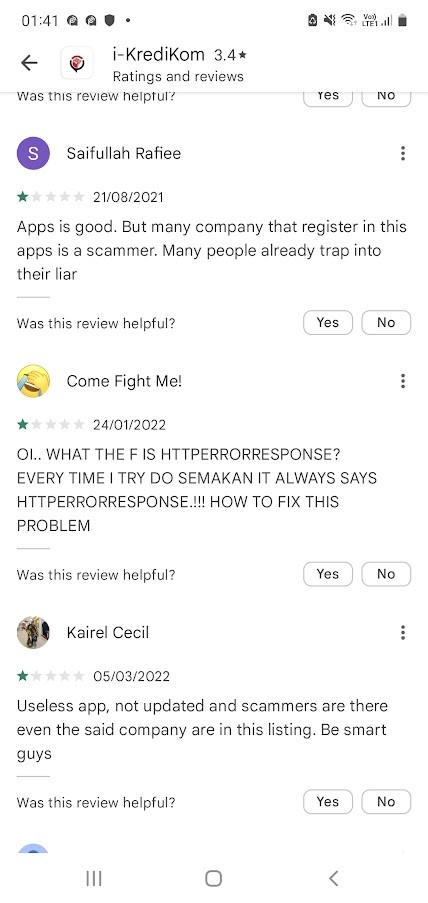
This may seem like redundant advice, but it is nonetheless important to emphasize. For example, “I-KREDIKOM” is an app that was created by the Ministry of Housing and Local Government (KPKT) to provide a platform to list licensed moneylenders and for the public to make complaints about any misbehaviour on the part of these moneylenders.[4] But in an ironic twist, this app – which received a rating of 3.4 – has been infiltrated by scammers who have someone managed to list themselves in this app, as indicated by many of the reviews (Appendix 2). This is a clear example of where the people in charge of rolling out this app at the Ministry in question failed to do the proper follow up and due diligence.[5]
3) Listen and respond to the feedback given by users
When an App has been downloaded more than 1000+ times and has received more than 100 ratings, the feedback will be a fairly accurate representation of how useful and user-friendly an app is. The Ministry or Government Agency in question MUST review this feedback and take the necessary steps to respond and rectify accordingly.
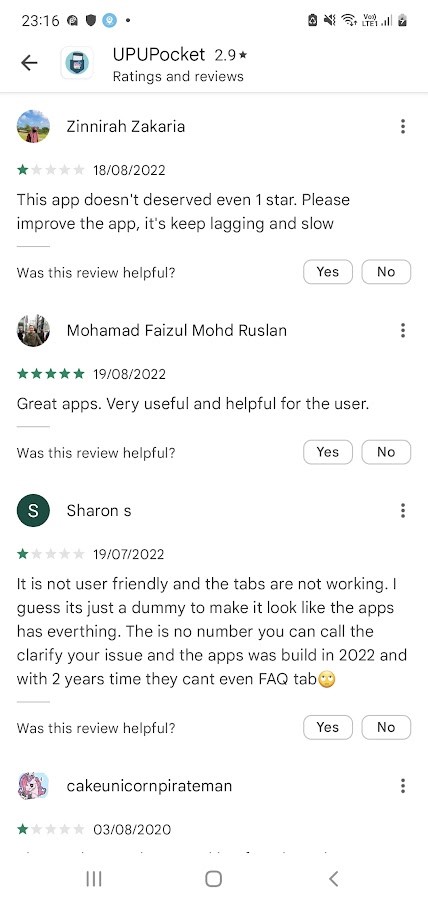
For example, UPU Pocket[6] is an app which has been downloaded more than 500k times by students and parents of students who are or have applied for entry into a public institution of higher learning (IPTA). The rating of this app is a miserable 2.9 and it has more than 1000 reviews most of which are negative. There is no official feedback in response to these complaints in the review section (Appendix 3).
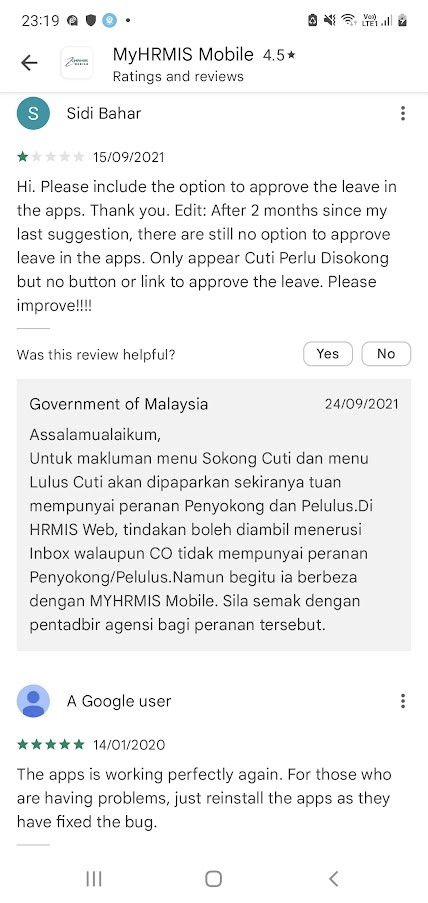
The MyHRMIS mobile app[7], which has been downloaded more than a million times, is frequently used by civil servants for HR purposes such as applying and checking on their leave. It has a rating of 4.5 and more than 7000 reviews. Even though not all of the reviews are positive, whenever a suggestion is given by a reviewer, there will be a response from the app developer (Appendix 4).
4) Update Apps regularly
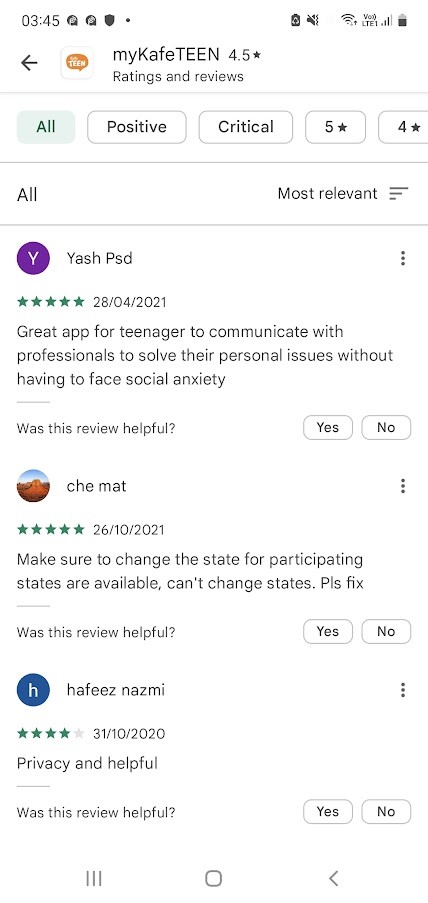
Apps, especially those with a high level of usage, should be updated regularly to fix bugs in the system, to increase functionality and respond to user feedback. The above mentioned MyHRMIS app was updated very recently in August 2022. In contrast, an app called “MyKafeTeen”[8], which has been downloaded more than 5000 times and has a high rating of 4.5, has not been updated since December 2019 (Appendix 5). This app, developed by LPPKN[9], an agency under the Ministry of Women, Family and Community Development (KPWKM)[10], with the intention of helping teens connect with doctors and counsellors, could have been used to a much higher degree during the pandemic to provide counselling advice to teenagers. Additional functions could also have been added if this app was updated during the pandemic.
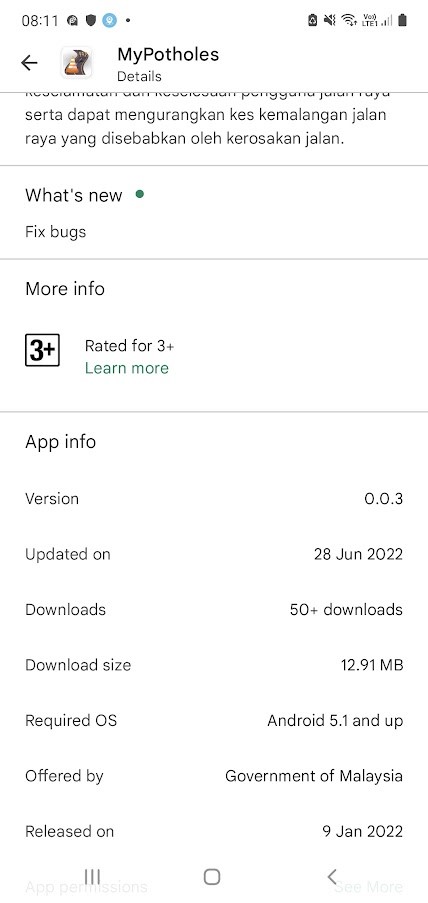
Of course, even when apps are updated regularly, this doesn’t mean that its usage, user-friendliness and effectiveness has increased. For example, the MyPotholes app[11], which was developed by the Ministry of Works, was recently updated in June 2022 but only has 50+ downloads and does not have enough ratings to register a score (Appendix 6).
5) Force the Minister / Deputy Minister and KSU to use the Apps developed by their respective Ministry / Agency
One way to ensure that the respective Ministries will pay closer attention to the effectiveness of their own apps is to force the Minister / Deputy Minister / Secretary General (KSU) to use these apps, especially during a public event. This will force the leadership of the respective ministries to go through the experience of a regular user. Some Ministers may even read the reviews on Google Play or the Iphone App Store and take some remedial action!
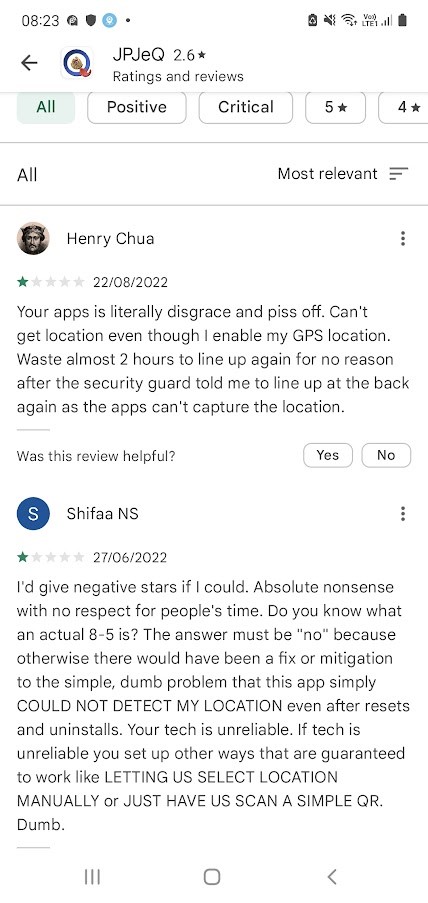
For example, it would be good to have Wee Ka Siong use the JPJeQ[12] app to try to book an appointment at a JPJ branch in his home state of Johor. This app, which was launched in Jan 2021, has had over 500,000 downloads and a rating of 2.6 with many users saying that the app cannot capture the GPS location of the user. (Appendix 7)
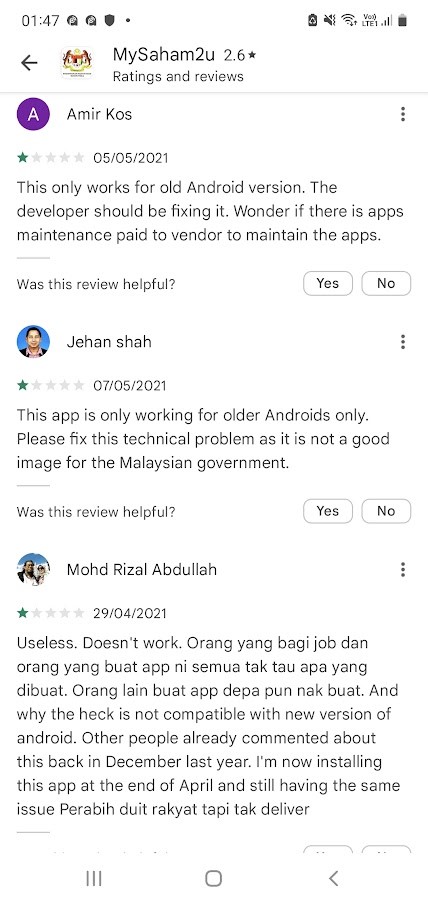
Here, I must also take some responsibility for not looking into the MySaham2U[13] app that was launched by MITI in January 2018. This app has been downloaded more than 10k times and has a poor rating of 2.6 (Appendix 8). This app is supposed to help those who have applied for Bumiputera shares keep track of their application. In my defence, I purposefully stayed away from the issue of Bumiputera share allocation during my time at MITI since this was a political sensitive issue which could have been used to attack me and my party.
6) Add functionality which will be useful for the user e.g. MyCuaca weather warnings
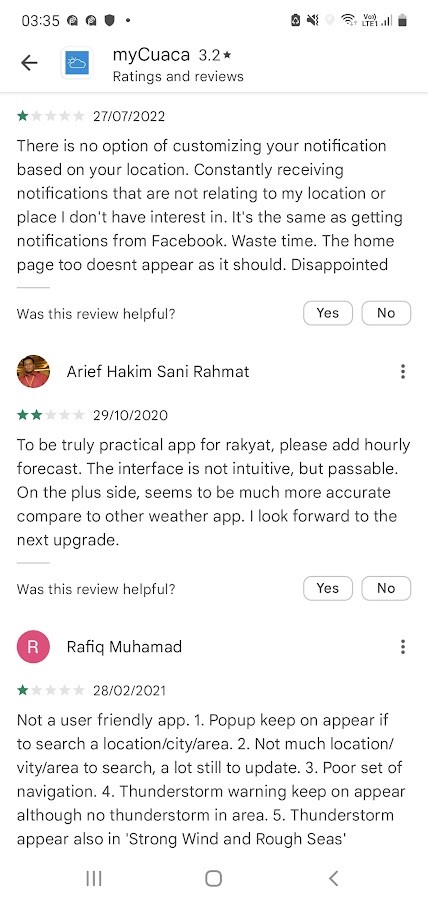
Some apps have the potential to provide very timely and useful information but because of the lack of functionality, they fail to fulfil their full potential. For example, the MyCuaca App[14], developed by the Malaysian Meteorological Department (MET Malaysia), has been downloaded over 100,000 times but only has a rating of 3.2. Among the complaints in the user review include poor location identification, the lack of hourly updates and the poor notification options (Appendix 9). One can imagine how this app can be very useful especially as we approach the monsoon season at the end of the year.
7) Check to see if the private sector has better alternatives (and work with them to improve delivery)
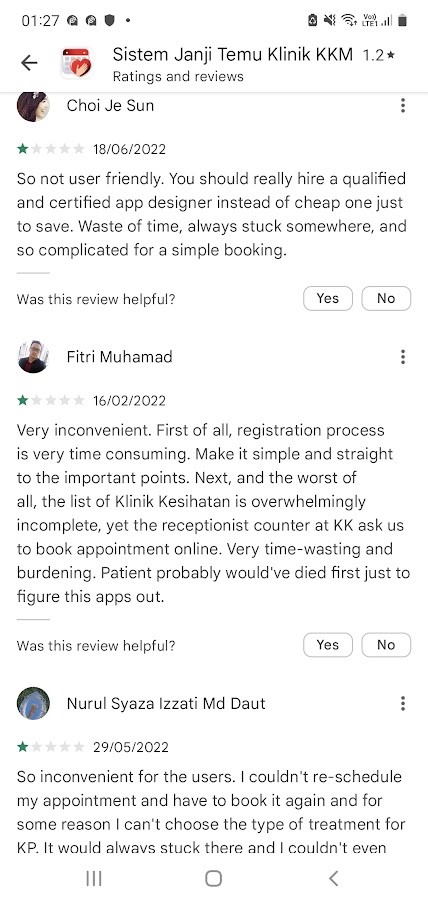
There are some apps with very poor ratings which should be discarded and replaced with existing options which are already available in the marketplace. For example, the “Sistem Janji Temu Klinik KKM”[15], which has been downloaded more than 100,000 times has one of the poorest ratings among all of the apps listed in the Gamma.my website: 1.2 out of 5 (with more than 1000 reviews) (Appendix 10). This kind of appointment booking app can easily be replicated using models which already work in the private healthcare system.
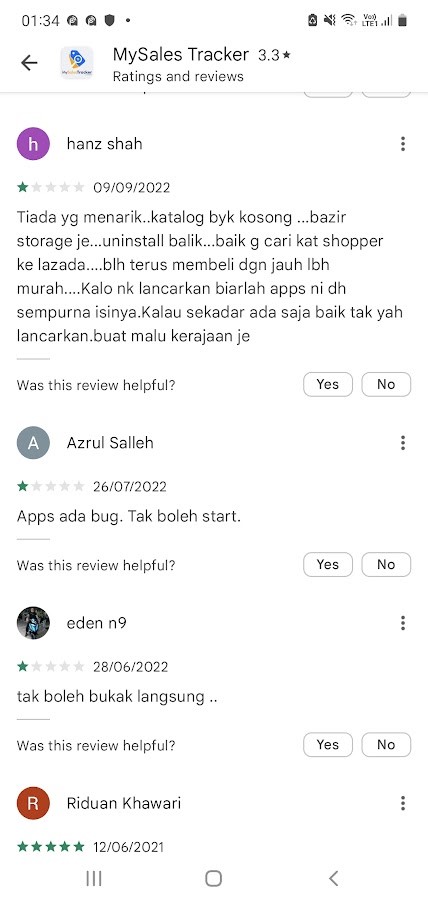
MySalesTracker[16], an app developed by the Ministry of Domestic Trade and Consumer Affairs (KPDNHEP[17]), is supposed to show information on cheap sales notices around the country. Sadly, it has only been downloaded about 5000 times and has a rating of 3.3. (Appendix 11). Contrast this with Hargapedia[18], an app which can be used for price comparison and online shopping for grocery, health and beauty products, which has been downloaded more than 500K times and has a rating of 4.2. Wouldn’t it be better for KPDNHEP to work together with private sector companies like Hargapedia (and others) to leverage on the reach and functionality of their apps rather than develop an underutilized app like MySalesTracker themselves?
8) Check that the private sector alternatives maintain a high standard e.g. MyEG
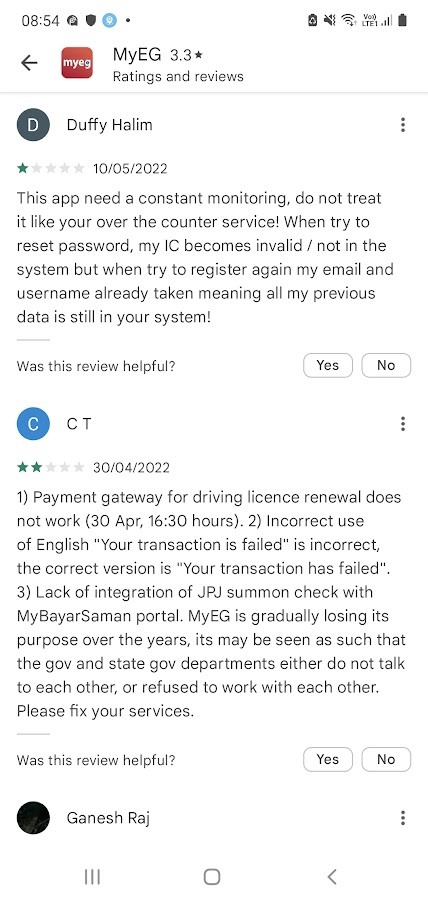
In cases where the processing of certain government related services has already been given to a private company, MAMPU also has the responsibility of making sure that the service provided by these private companies are up to par. MyEG[19], for example, is a publicly listed company which has a popular app which has been downloaded more than a million times. But it’s rating is only 3.3 and the recent user reviews shows a drop in the level of service. (Appendix 12)[20]
9) Work with the state governments on selected apps and functions
MAMPU should also recommend that certain Ministries, especially the Ministry of Housing and Local Government (KPKT) and the Ministry of Works (KKR), work together with the state governments (and local councils) to implement and improve public complaint or “e-aduan” type apps. There is no point for KPKT to have its own “I-TEGUR” app (rated 2.2 with 10K+ downloads) for public complaints when most of these complaints will have to be channelled down to the local councils. At the same time, it would make sense for the state governments to learn from the best practices at the national level so that it can implement these for the apps which are relevant to public complaints at the local authority (“Pihak Berkuasa Tempatan”) level.
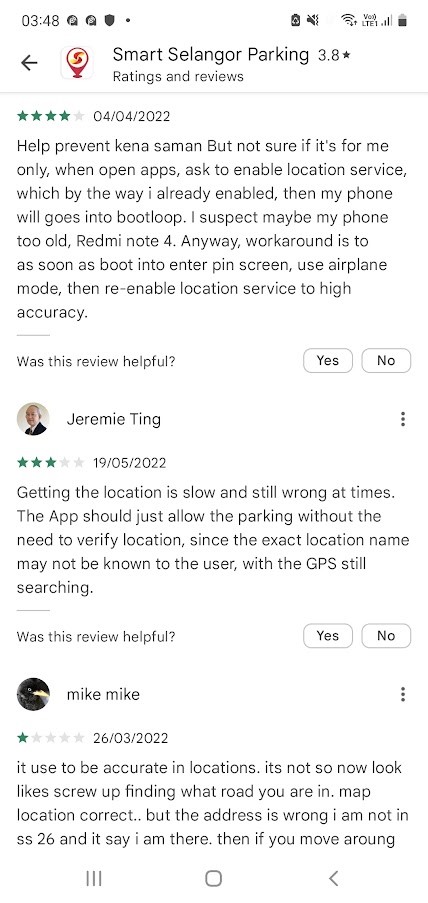
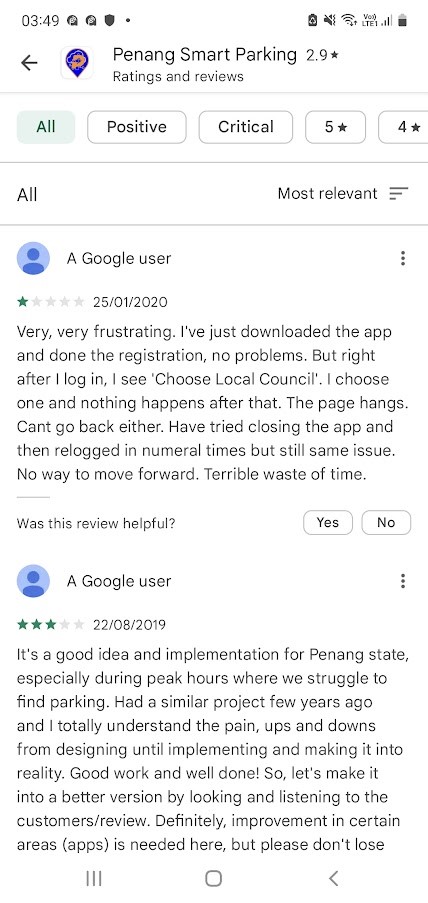
I must admit that this has been a challenge for me at the local council level. It has been hard to develop a well-functioning app for public complaints for the Kajang municipal council (MPKJ). Previous apps have failed to achieve their objective for a variety of reasons. It makes sense for the Selangor state government to consolidate the public complaints process using one app at the state level similar to what it has done for the Smart Parking system under the Smart Selangor Delivery Unit (SSDU). This parking app has been downloaded over 500,000 times and has a decent rating of 3.8 (Appendix 13). Of course, there is continued room for improvement not just for the Selangor state government but also for the Penang state government which has a Smart Parking app that has a rating of only 2.9 (Appendix 14). Better coordination between the federal and state governments would be helpful in this regard.
10) Adopt best practices from some of the better rated apps
Again, MAMPU can be the main coordinator to provide advice and consultation to the governments and agencies at the state and federal level on what are some of the best practices to make apps more user-friendly and functional.
11) Ensure data protection and privacy e.g. MySejahtera
Data privacy is very important to ensure the users that their personal data that is stored on an app will not be misused or hacked or sold to a third party. This is the challenge faced by MySejahtera when it was discovered that the developer may be able to use the data collected for private and commercial purposes. This is a lost opportunity as MySejahtera can be used by the Ministry of Health for many health-related projects for long term health tracking of the population e.g. tracking those with possible Long COVID symptoms.
12) Find a way to crosscheck the validity of ratings of Apps (especially those with high ratings)
Last but not least, MAMPU should find a way to limit the possibility of people ‘skewing’ the ratings of apps because they want to artificially inflate it to make a Ministry look good or because they want to artificially depress the rating to make a Ministry look bad.
[1] https://twitter.com/WongShuQi/status/1555054022977257473
[2] https://www.mampu.gov.my/en/
[3] https://play.google.com/store/apps/details?id=my.gov.onegovappstore.MyWc&hl=en&gl=US
[4] https://play.google.com/store/apps/details?id=my.gov.onegovappstore.iKrediKom&hl=en&gl=US
[5] This app was rolled out by the Ministry of Housing and Local Government (KPKT) on the 26th of March 2019 when Zuraida Ibrahim was the Minister.
[6] https://play.google.com/store/apps/details?id=my.gov.onegovappstore.upupocket&hl=en&gl=US
[7] https://play.google.com/store/apps/details?id=my.gov.jpa.eghrmis.mobile&hl=en&gl=US
[8] https://play.google.com/store/apps/details?id=com.kafev2&hl=en&gl=US
[9] https://www.lppkn.gov.my/lppkngateway/frontend/web/
[10] https://www.kpwkm.gov.my/
[11] https://play.google.com/store/apps/details?id=my.gov.onegovappstore.mypotholes&hl=en&gl=US
[12] https://play.google.com/store/apps/details?id=my.gov.jpj.queue&hl=en&gl=US
[13] https://play.google.com/store/apps/details?id=my.gov.onegovappstore.mysaham2u&hl=en&gl=US
[14] https://play.google.com/store/apps/details?id=my.gov.met.mycuaca&hl=en&gl=US
[15] https://play.google.com/store/apps/details?id=my.gov.onegovappstore.janjitemuKKM&hl=en&gl=US
[16] https://play.google.com/store/apps/details?id=my.gov.onegovappstore.mysalestracker&hl=en&gl=US
[17] https://www.kpdnhep.gov.my/ms/
[18] https://play.google.com/store/apps/details?id=com.askhargapedia.app&hl=en&gl=US
[19] https://play.google.com/store/apps/details?id=mf.myeg.com.eservicemobile&hl=en&gl=US
[20] To be fair to MyEG, it does respond to many of the negative user reviews in Google Play Store.