Last Wednesday (27 July 2022), a new bill – Tobacco Product and Smoking Control Bill, was tabled in the Parliament for the first reading. This was the first time the MPs read the bill. Since then, there are many discussions on the merits and demerits of the bill.
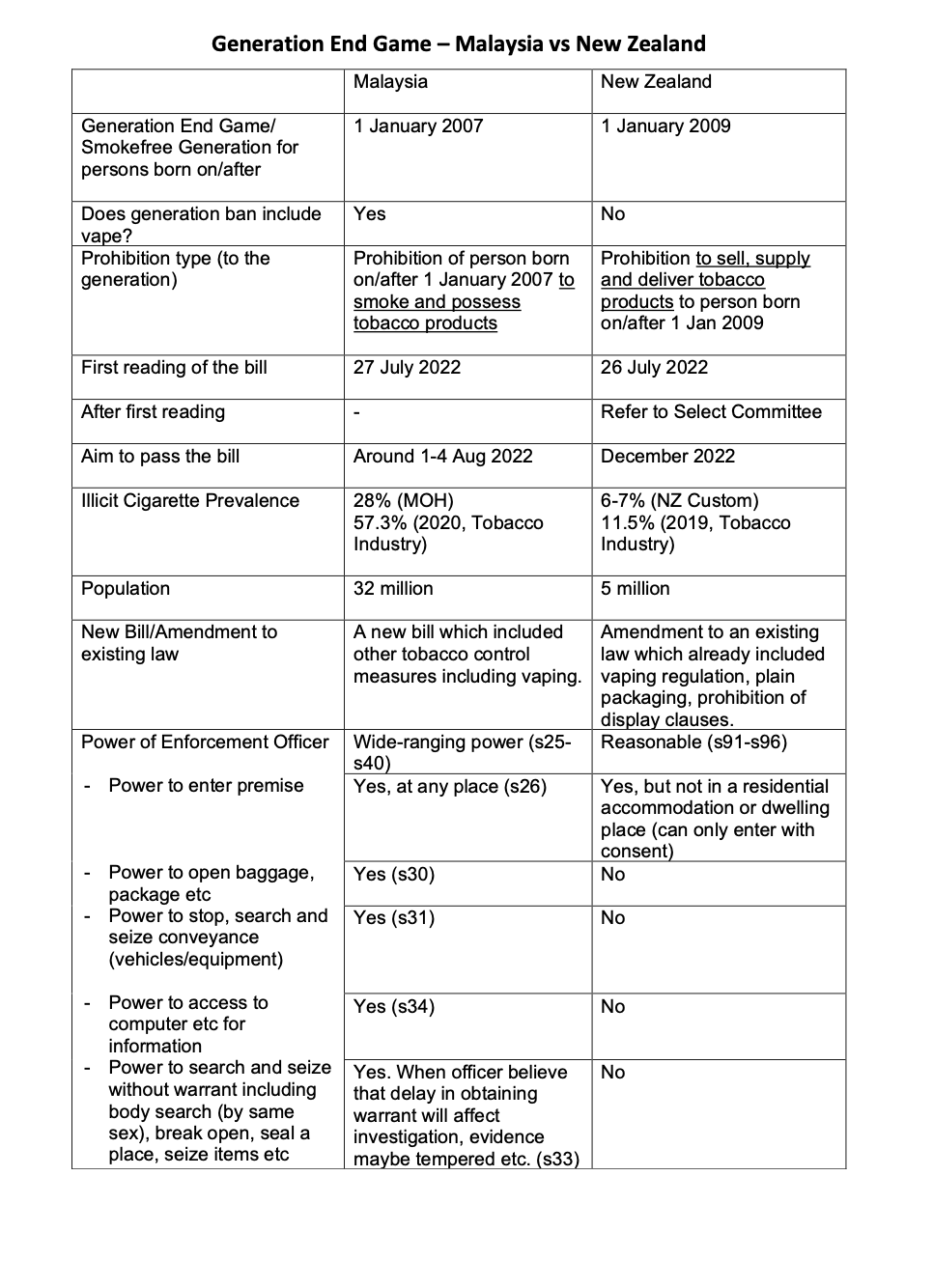
The most discussed tobacco control measure in the bill is what is touted as the Generation End Game (GEG), which seeks to ban the entire generation from all tobacco products. In fact, the day before this bill was tabled in the Malaysia Parliament, Smokefree Environments and Regulated Products (Smoked Tobacco) Amendment Bill was tabled in New Zealand Parliament, which included New Zealand’s version of GEG. (Theirs is called Smokefree Generation.) The table attached show the difference between Malaysia and New Zealand version of GEG.
With illicit cigarettes prevalence at 6-7% according to New Zealand Custom (or 11.5% according to Tobacco Industry), New Zealand aims to start generation ban on smoked tobacco products (i.e not including vaping) for those born on/after 1 January 2009. On the other hand, Malaysia illicit cigarettes prevalence is at 28% according to MOH (or 57.3% according to Tobacco Industry) – with 4 times weaker enforcement capability, aim to start generation ban on all tobacco products (i.e including vaping) two years earlier – for those born on/after 1 January 2007. Is our start date of generation ban achievable? Should we include vaping in the generation ban?
New Zealand’s version of GEG prohibits to sell, supply and deliver tobacco products to person born on/after 1 Jan 2009, whereas Malaysia GEG includes prohibition of person born on/after 1 January 2007 to smoke and possess tobacco products. Which type of prohibition is more effective? Or is prohibition the right way to go?
In addition, Tobacco Product and Smoking Control Bill is a new bill, which also include other tobacco control measures such as vape industry regulation, plain packaging, prohibition of display etc. What is the impact to the society when this law come into force? Public should note that there is no Regulatory Impact Assessment report available to the MPs to consider.
In term of enforcement, Malaysia Tobacco Product and Smoking Control Bill give wide- ranging power to the enforcement officers whereas New Zealand enforcement officers only has the power to enter premises that are not residential or dwelling place for investigation and other enforcement actions will need a warrant. Why do enforcement officers in Malaysia need so much power that the New Zealand officers don’t? Do these clauses infringe personal privacy and human rights?
I do not have definite answers to most of the questions above and would like to listen to more views (other than Ministry of Health) from different parts of the society. I believe most MPs wish to do that too and they may have more questions to the bill that require answers.
New Zealand MPs are given four months to consider amendment to an existing law, but Malaysia MPs is expected decide in less than a week for an entirely new bill. Is it right for Malaysia MPs to support a bill without much deliberation in the name of good intention?
I hope that the Tobacco Product and Smoking Control Bill will be sent to the following Parliamentary Select Committees: i. Health, Science and Innovation, ii. Women, Children and Social Development, and iii. Fundamental Liberty and Constitutional Right, for further deliberation with different stakeholders, and that the Ministry of Health will do a comprehensive regulatory impact assessment on the bill. The reports from these committee and the ministry can then be tabled to the MPs to consider the bill more comprehensively.
Let us together make a good law to achieve the good intention of reducing smoking prevalence in Malaysia.
Information on New Zealand amendment is available here: https://www.parliament.nz/en/pb/bills-and-laws/bills-proposed- laws/document/BILL_125245/smokefree-environments-and-regulated-products-smoked-tobacco