
I must admit that I, like many other Malaysians, had a very negative reaction upon reading news reports that the European Medicines Agency (MDA) does not ‘recognize’ the AZ vaccines that were recently donated to Malaysia by Japan.[1] But upon further study, I realized that this was a gross overaction and that I had failed to educate myself on this issue.
Firstly, the EMA is not supposed to ‘recognize’ any vaccines that are produced outside the EU which are not meant for the EU market. Most of the supplies of the AZ vaccine which are being used in the EU are manufactured in Belgium as well as in the United States.[2] Like any pharmaceutical regulator, the EMA would only be concerned about the manufacturing process at the facilities where the vaccines are being made. It would not be concerned with the AZ manufacturing facilities in Japan which were producing mostly for the domestic market and also in India (via the Serum Institute) which were producing for the domestic market as well as for the low to mid income countries as part of the COVAX supply agreements.
Secondly, the fact that EMA did not recognize these AZ vaccines from these production facilities does not mean that these vaccines are somehow “less safe”. For example, the National Pharmaceutical Regulatory Agency (NPRA) in Malaysia has not yet recognized the COVID19 vaccine currently being produced by MODERNA but this vaccine is already being widely used in many countries including in Singapore.
Thirdly, the EMA ‘non-recognition’ is not a restriction (as far as I know) for Malaysians who have taken the AZ vaccine to travel to Europe. I needed to be reminded that the EMA is a government agency just like the NPRA with a specific mandate and set of responsibilities. The EMA does not decide the rules with regards to international travel to and from EU countries. When it comes to travel to and within the European Union (EU), a European Commission spokesman said that travelers who are fully vaccinated with vaccines authorized in the EU “should” be allowed entry for non-essential travel even if these vaccines were not “produced in facilities covered by the marketing authorisation in the EU.”[3]
Fourthly, the travel policy with regards to Malaysia travelling to the EU is still governed by the rules and policies of individual countries. For most EU countries, the indicators which are of concern are the number and variant of COVID19 cases and the rate of spread in the country from which an individual is travelling from. What this means is that we should be more concerned about increasing the vaccination rate domestically as part of the larger strategy of containing the COVID19 virus so that we are not put on any ‘banned list” of any country meaning that our citizens or those who are residing in Malaysia are banned from travelling to a country in the EU (or anywhere else, for that matter). In Germany, for example, there are indicators[4] which have been publicly published which categorized countries into “Areas of Variant of Concern” (effectively a ban travel list), “High Incidence Areas” (of which Malaysia entered into starting on the 14th of June, 2021) and “Base Risk Areas”.[5]
Within individual EU countries, I am not aware of any country which has announced a differentiated treatment for individuals who have been vaccinated with the AZ COVID19 vaccines produced in facilities which are recognized by the EMA (VAXZEVRIA) versus AZ COVID19 vaccines produced in facilities which are not recognized by the EMA (COVISHIELD). For example, in Germany, its equivalent of our NPRA, the Paul Ehrlich Institute (the Federal Institute for Vaccines and Biomedicines) states the following[6]:
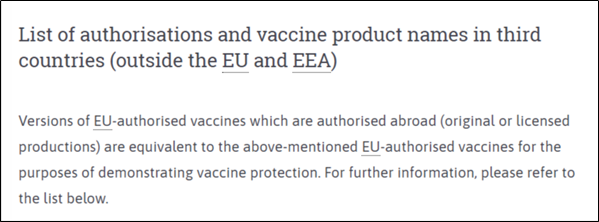
… and Malaysia’s COVID19 AZ Vaccine is listed here.

For the United Kingdom, which is no longer in the European Union, and is probably the most visited European country by Malaysians, the main challenge for us is to ensure that our country doesn’t fall into the list of “RED” countries and territories which means that Malaysians cannot travel to the UK regardless of vaccination status.[7] We are currently in the “AMBER” list which means that we have to take a COVID19 test before travelling to England, quarantine in a hotel or at home for 10 days and pay for a COVID19 tests in Day 2 and Day 8 of the quarantine. Instead of focusing on vaccine recognition, we should instead work towards achieving the status of a “GREEN” country where we have to take a COVID19 test before travelling to the UK and have another test on day 2 of our visit. No home or hotel quarantine is required unless the COVID19 test result is positive.
To repeat, let us not overreact but focus instead on increasing our vaccination rate which is a crucial step towards bringing down the COVID19 numbers and allow the economy to reopen again, slowly but surely.
[2] https://www.bbc.com/news/56483766
[3] https://healthpolicy-watch.news/those-vaccinated-with-covishield/
[4] Number of new infections per 100,000 inhabitants for the past 7 days.
[7] https://www.gov.uk/guidance/red-amber-and-green-list-rules-for-entering-england