
Yesterday, on the 15th of January 2018, the Election Commission (EC) issued the 2nd Notice (or Syor 2) for the Delimitation Exercise for the state of Selangor. The delimitation exercise for all the other states in Peninsular Malaysia have been completed with the exception of Selangor. With the publication of the 2nd notice and the completion of the 2nd public hearing, the EC can then pass the delimitation exercise for Peninsular Malaysia to the Prime Minister who is expected to table this and also the Sabah delimitation exercise in the upcoming March to April 2018 parliament sitting.
At first glance, Syor 2 seems to return the boundaries of the seats in Selangor back to the boundaries which were used in the 2013 general election, with the exception of 5 parliament seats and name changes to one parliament and four state seats. But by returning to the GE13 status quo, the EC shows that it has failed to achieve one of the key objectives of any delimitation exercise, which is to reduce the disparity between the number of voters in the parliament and state seats.
For example, the parliament seat of Kapar (146,317 voters) still has nearly 4 times as many voters as the parliament seat of Sabak Bernam (37,126) under Syor 2. (See Figure 1 below)
Figure 1: No of voters by Parliament Seat in Selangor according to Syor 2
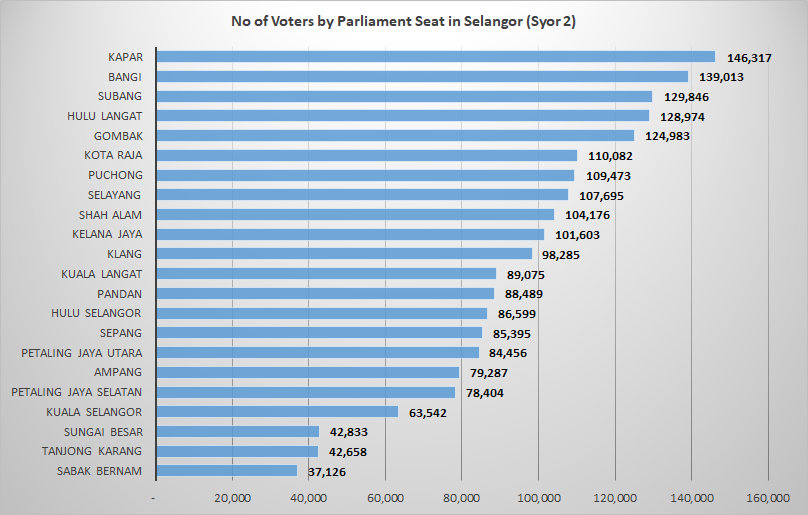
It would be hard for an independent and impartial EC to argue for a ‘rural-weightage’ of nearly 4 to 1 for a developed state like Selangor where even areas like Sabak Bernam and Tanjong Karang are well connected by roads and highways.
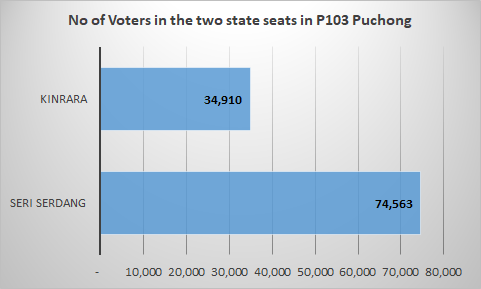
At the same time, the EC has failed to reduce the disparity in the number of voters between state seats, even for those located in the same area. For example, the number of voters in Seri Serdang and Kinrara in Syor 2 are 74,563 and 34,910 respectively even though both of these state seats are in the urban seat of P103 Puchong and are under the jurisdiction of the Subang Jaya Municipal Council (MPSJ) (See Figure 2 below). The fact that Seri Serdang has more than twice the number of voters in Kinara even though they are both urban seats is a gross violation of Section 2(c) of the 13th Schedule of the Federal Constitution.
Figure 2: No of Voters in the two state seats in P103 Puchong in Syor 2
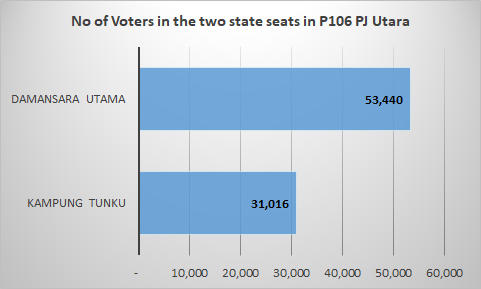
Another example can be found in the parliament seat of P106 PJ Utara. The number of voters in the two state seats in PJ Utara are 53,440 (Damansara Utama) and 31,016 (Kampung Tunku) respectively even though both of these state seats are urban seats under the Petaling Jaya municipal council. (Figure 3 below)
Figure 3: No of Voters in the two state seats in P106 PJ Utara (Syor 2)
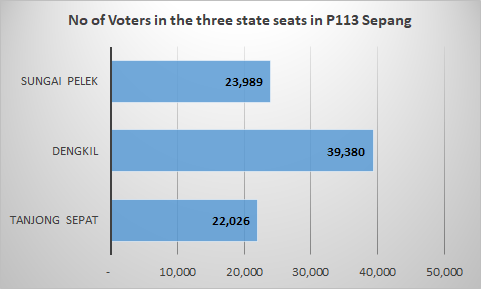
Similar discrepancies can be found in the state seats in P113 Sepang. The state seat of Dengkil (39,380 voters) has almost twice as many voters as Sungai Pelek (23,989) and Tanjong Sepat (22,026) even though all of these seats are located under the Sepang Municipal Council (See Figure 4 below)
Figure 4: No of voters in the three state seats in P113 Sepang (Syor 2)
For a state which has experienced such a rapid growth in the number of voters such as Selangor, what the EC should have done is to increase the number of state and parliament seats in order to reduce the discrepancy in the number of voters in the state and parliament seats in accordance to Section 2(C) of the Federal Constitution which states that the number of voters within each constituency in a State ought to be approximately equal with some measure of urban-rural weightage.
It is not the responsibility of the EC to ensure that the Selangor state will amend its state constitution to cater for the increase in the number of seats nor is it the responsibility of the EC to ensure that there is enough support in parliament to amend the constitution to increase the number of parliament seats. This responsibility lies solely in the hands of the Prime Minister. The Prime Minister must convince 2/3rds of MPs in parliament that the delimitation exercise is worthy of their support in order to amend the federal constitution and increase the number of parliament seats. Similarly, the Prime Minister must work with and obtain the agreement of the Selangor state to increase the number of state seats.
So even though Syor 2 does not exhibit the gross gerrymandering that was evident in Syor 1, the EC has very obviously failed in adhering to the Federal constitution in carrying out the delimitation exercise for Selangor.