
I welcome the announcement made by Deputy Prime Minister Tan Sri Muhyiddin Yassin that our government plans to introduce the “30% Club” to increase women participation in decision-making positions in the public and private sectors.
The 30% Club was first launched in UK by Helena Morrissey, CEO of Newton Investment Management as the Club founder, together with a group of business leaders committed to achieving better gender balance at all levels of organizations on November 9, 2010. It was subsequently launched in New Zealand, Hong Kong, US and Ireland.
The goal of the 30% Club is to have 30% women on FTSE 100 boards by end 2015. Since the launching of the Club, accelerated progress has been achieved. There are currently 22.2% women on FTSE 100 boards, up from 12.6%.
Introducing the 30% Club is a good effort, however more need to be done to increase women participation in decision-making positions.
Women labour force participation rate has increased from 46.8% in 2010 to 52.4% in 2013, but even if we achieve the target to increase women labour force participation rate to 55% in 2015, the labor force participation rate of Malaysian women will still be among the lowest in East Asia.
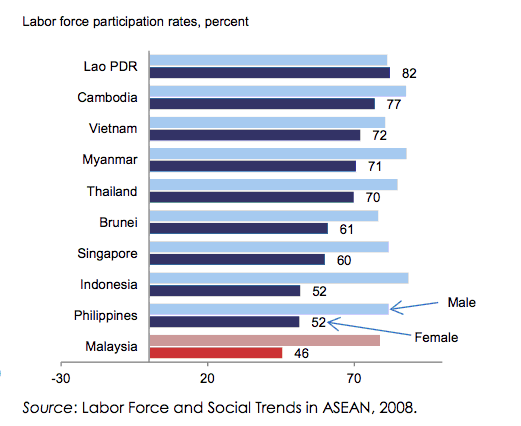
Lack of affordable and high quality childcare options outside the home influences women’s decision to stay out of the labor force. Despite the fact that a Roadmap for Leveraging Women’s Talent was developed in 2011, as at July 31, there are only 26 daycare centres registered at private companies, looking after 929 children up to age six, while 115 daycare centres provided for civil servants nationwide. The Government needs to urgently review its effort to improve the access to childcare.
Besides, it is time to introduce eliminating gender discriminatory legislation in Malaysia, such as instituting formal equal pay for equal work laws for the private sector, and strengthening sexual harassment legislation.
Thirdly, we should also review our parental leave policies. Malaysian women have 60 days of maternity leave in the private sector whereas men in the private sector do not have a legally mandated leave benefit. This will likely reduce employers’ incentives to hire female workers because of the additional costs of hiring women, particularly among younger age groups.
To overcome this problem, countries like UK, Norway, Sweden and Iceland have adopted the shared parental leave policy.
I appreciate the efforts of the Government to make the working environment more women and family-friendly and I urge both BN and PR to work hand in hand to introduce more work-life balance policies to benefit all Malaysians.