
When the Malaysian government announced the temporary ban on the export of chickens at the end of May 2022 (including live poultry, whole carcasses, chilled and frozen meat, chicken parts and chicken-based products[1]), I had already warned that this short-term measure will harm our chicken products in the long term.[2] I wrote:
“Ironically, the decision to ban the exports of chickens, which may look like a workable short-term solution, will end up hurting local chicken producers and even chicken imports for the following reasons:
- This will decrease the level of cross-subsidy available to local chicken farmers since they can earn more from their export sales to countries in like Singapore;
- Local chicken farmers may have to pay compensation because of possible breach of contractual obligations to their overseas customers and;
- Many of the countries which import from Malaysia will be forced to look for other supply sources in the region and they will be able to offer better prices compared to Malaysian retailers who are looking to diversify their own import sources!
Even though this ban was eased in the middle of June 2022[3], the damage to the industry had already been done. This impact was felt most strongly in Singapore, which imports one third of its chicken supplies from Malaysia including almost all of its live chickens.[4]
Private food importers in Singapore immediately announced alternative supply sources of chicken from Thailand.[5] On the 1st of June 2022, the Singapore Food Agency (SFA) announced a list of new farms and establishments which could export their chicken products to Singapore including from Australia, Brazil and Thailand.[6] On the 30th of June 2022, the SFA announced the approval of three establishments in Indonesia to export chicken meat and chicken meat products to Singapore.[7] More recently, the Indonesian ambassador to Singapore announced the possible setting up of chicken farms in Batam to export live chickens to Singapore.[8]
The Ministry of Agriculture and Food Industries (MAFI) must understand that the path to food security in the country is not only to provide enough supplies for the domestic market but also be able to produce enough supplies to export to foreign markets. Countries like Thailand and Vietnam can produce more than enough rice for their domestic market because they are also rice exporting countries. Instead of harming local chicken farmers by short-term policies such as the export ban and by putting in price controls that are not reflective of the underlying cost of production, MAFI should be putting in place plans to help our chicken farmers expand their domestic production AND access to foreign markets. When our chicken farmers can earn more from the export market, they would be in a better position to manage the price of chicken and eggs in the domestic market.
Some policy recommendations for MAFI to pursue includes:
- Working with the industry including the members of the Federation of Livestock Farmers Association of Malaysia (FLFAM)[9] to provide soft loans via Agrobank for long term investments and expansion in this sector;
- Working with MATRADE, an agency under the Ministry of International Trade and Industry (MITI), to expand market access for our chicken producers to other countries which import chicken and chicken products including for the halal markets in the Middle East;
- Utilizing its agencies on how to assist the industry to increase its productivity and reduce the reliance on foreign workers including via investments in automation and Industry 4.0 best practices;
- Working with state governments and land-owning Government Linked Companies (GLCs) to identify areas for new chicken farms including via strategic Joint Venture (JV) partnerships;
- Understanding the underlying cost structure of chicken farmers and making it easier for these players to claim for the announced subsidies for chickens and chicken eggs;
- Assuring our export markets, especially Singapore, that such export bans will not be implemented again and that contractual sanctity will be respected.
According to the Federation of Livestock Farmers Association of Malaysia (FLFAM), 21 chicken farms which produce more than 2 million eggs have closed over the past 3 years because of the pandemic, the shortage of labour and the increase in the cost of operations. (See Appendix 1 below). Strategic thinking, coordination and planning are needed on the part of MAFI and the Malaysian government to prevent further closures from happening especially since the cost pressures on chicken farmers will continue to be present.
Appendix 1: List of Chicken Farms closed down in the past 3 years
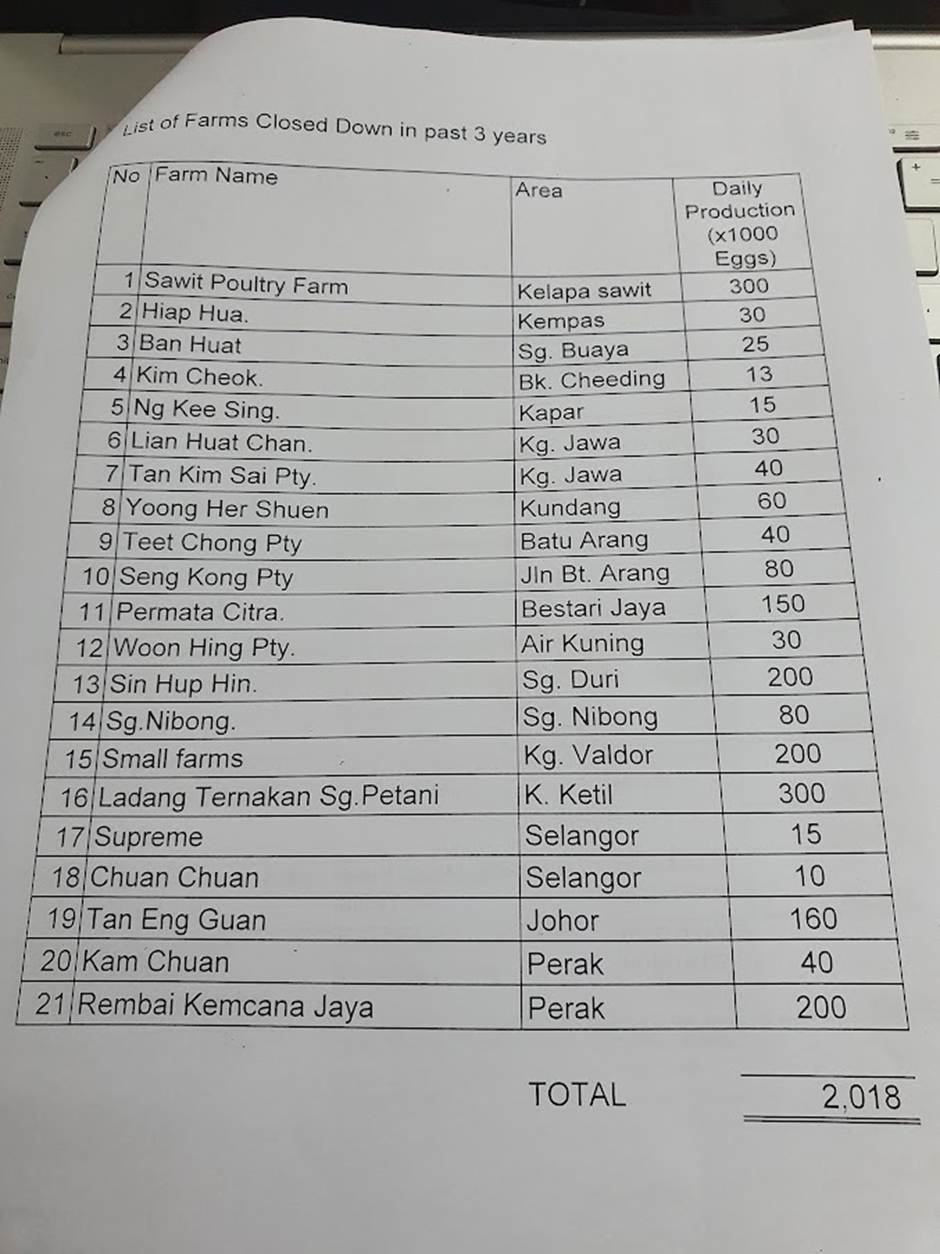
Source: Federation of Livestock Farmers Association of Malaysia (FLFAM)